February 4, 2026
7 Best Employee Advocacy Tools in 2026: A Detailed Review
X Minute gelesen


Soziale Infrastruktur, die mit Ihnen skaliert.
Starten Sie Ihre kostenlose Testversion oder lassen Sie sich von uns die Plattform in Aktion zeigen.
Employee advocacy is one of the most practical extensions of how companies communicate on social media. When organic reach declines, audiences place more trust in people than brands. That is why employee-shared content plays an increasingly important role in visibility, credibility, and employer branding.
Employee advocacy tools give structure to this process. This allows your organization to curate content, guide employee participation, and maintain oversight without turning advocacy into a forced program.
In this blog post, we'll review the 7 best employee advocacy tools in 2026. The focus is on real-world use cases and platform capabilities. Each tool is evaluated based on its support for content distribution, moderation, analytics, and internal engagement.
What is Employee Advocacy Software?
Employee advocacy software makes it easy for your team to share company content on their personal social media accounts. Think of it as a content library where your marketing team puts approved posts, images, and captions. Employees log in, select what they want to share, customize it if needed, and post to LinkedIn, Twitter, Facebook, or Instagram.
Most of these tools also offer analytics to track important metrics. You can see which posts get the most likes and comments, who's sharing the most, and whether all this effort is actually driving results.
How to Evaluate Employee Advocacy Software
Here are a few important criteria to keep in mind before comparing the tools:
1. Content Sourcing and Curation
Good employee advocacy software pulls content from multiple sources, including blogs, social channels, and employee-generated posts. This reduces manual effort and keeps feeds relevant.
2. Moderation and Governance
Some of the best employee advocacy tools for enterprises include robust governance and moderation policies. This makes it easy to review and approve content and includes role-based access controls. This is important to avoid any compliance issues that could slow down participation.
3. Analytics and Reporting
Social media reporting is key. It shows which employees are engaging, which content performs best, and how well advocacy contributes to your brand’s reach and engagement.
4. Integration and Distribution
Not all software supports this, but it is useful to look for tools that allow content embedding into intranets, collaboration tools, and internal portals. This can help increase visibility and adoption.
Top Employee Advocacy Tools: Quick Comparison Table
#1. Flockler
G2 rating: 4.8/5

Flockler is primarily known for social media aggregation and is not your traditional employee advocacy tool. Unlike other employee advocacy software, Flockler does not distribute pre-approved posts to employees for social media sharing.
Instead, it supports employee advocacy by aggregating, moderating, and surfacing employee-generated social content in a controlled and visible way.
The platform collects public posts from employees on channels such as LinkedIn and organizes them into centralized social feeds. These feeds can be reviewed before publishing to company channels or intranets. This allows communications and employer branding teams to apply moderation rules and remove content that does not align with internal guidelines.
A common use case is internal advocacy and visibility of culture. Many organizations embed these curated social feeds into intranet environments like SharePoint. This gives employees ongoing exposure to real examples of how colleagues talk about the company publicly.
Flockler also supports AI-assisted moderation with Garde AI, helping teams manage higher content volumes while maintaining review standards.
Key features:
- Social media aggregation from platforms such as LinkedIn, Instagram, YouTube and more
- Moderation workflows for reviewing employee-generated content
- Embeddable social feeds for intranets and internal hubs
- AI-assisted moderation with Garde AI
- Content organization to collect and surface posts by event, campaign, topic, etc.
- Actionable metrics and reports, including content leaderboards to improve ROI
Pros:
- Works well for organizations prioritizing authenticity and governance
- Strong fit for intranet-based internal engagement
- Does not require employees to adopt a separate sharing app
Cons:
- Does not offer content distribution, sharing prompts, or advocacy gamification
- Advocacy impact is indirect and depends on internal visibility rather than campaigns
Pricing:
- Pricing starts at $129/month for the basic plan and suits small to medium-sized teams
- Business plan is $195/month
- Pro is $325/month
- Premium custom plans are also available
#2. Hootsuite Amplify
G2 rating: 4.4/5

Hootsuite Amplify is a traditional employee advocacy platform and is a part of the broader Hootsuite ecosystem. You can use it to share curated content through online channels and even connect it with your team’s favorite tools. All popular social platforms are supported, and marketing teams can even manage multiple profiles through Amplify. You can use it for hiring, promoting products, sharing company announcements and more.
The setup is simple, and employees can share pre-approved content from the dashboard in a few clicks. Performance and engagement can be tracked per post, including post impact and adoption rates.
Key features:
- Curated content feeds for employees to pick and choose for sharing
- One-click social sharing to platforms such as LinkedIn
- Content approval and governance workflows in place to moderate
- Analytics tied to Hootsuite’s broader reporting environment
Pros:
- Strong control over messaging and brand consistency
- Easy adoption for teams already using Hootsuite
- Clear reporting on employee participation and reach
Cons:
- Limited support for showcasing organic employee-generated content
- Less emphasis on internal visibility or culture-driven advocacy
Pricing:
Hootsuite Amplify is available as an add-on to Hootsuite plans. General pricing starts at $249 per user per month, with custom plans available for enterprises.
#3. Sprout Social
G2 rating: 4.4/5

Sprout Social offers a social media advocacy solution for employees, available as a standalone offering or with an existing Sprout account. The advocacy module is designed for structured content distribution, controlled sharing, and centralized reporting.
The workflow is fairly straightforward. Admins can add shareable content onto the RSS feed, share message ideas and have employees share them directly from the Sprout Social app or desktop. Real-time metrics updates allow teams to track leads, web traffic, and event registrations.
Key features:
- Publish approved posts with suggested copy, links, and media for employee sharing
- Share content directly to supported networks from the advocacy feed
- Single Sign-On for employees to use and manage login credentials for access
- Mobile app and desktop to share content instantly
- Insights into key metrics, including top contributors, adoption rate, engagement, etc.
Pros:
- Tight integration with Sprout Social’s publishing and analytics workflows
- Pre-approved shareable content feeds
- Integration with broader social workflows
- Suitable for organizations managing both brand and employee social activity in one platform
Cons:
- Onboarding and setup can be time-consuming
- Analytics has granularity limitations
- Identical employee posts can feel repetitive in social feeds.
Pricing:
Sprout Social pricing for the core platform, billed annually, is approximately:
- Standard: $199 per user/month
- Professional: $299 per user/month
- Advanced: $399 per user/month
- Enterprise: custom pricing
Employee advocacy functionality is offered as an add-on module. Pricing for advocacy is available upon request and may vary based on the number of users and contract terms.
#4. EveryoneSocial
G2 rating: 4.5/5

EveryoneSocial is an employee advocacy and social selling platform that helps employees share content across their networks. It provides a central feed of curated content, suggested messaging, and gamification features to encourage participation, while also offering analytics to measure advocacy impact and reach.
EveryoneSocial’s Modern Advocacy tool is simple to use and lets you share content directly from Slack, Gmail, etc. You also get analytics from day 1 and receive real-time updates. This employee advocacy software is ideal for executive comms.
Key features:
- Let employees share content from the tools and apps they use frequently
- OOTB integrations with Slack, SharePoint, emailing apps, etc.
- Visibility into employee-created and shared content to drive reach and engagement
- Compare your program against competitors
Pros:
- Easy for employees to use. The interface is generally considered intuitive
- Dedicated support team for hassle-free onboarding and ongoing support
- Works with existing SMM tools
- Employees can share content that supports personal branding and brand visibility
Cons:
- Onboarding and habit building take time
- Limitations in customizing features like leaderboards or dashboards
Pricing:
EveryoneSocial offers custom pricing only.
#5. Sociabble
G2 rating: 4.7/5

Sociabble is an all-in-one employee communication platform. It’s used for its 4 core features: internal communication, employee advocacy and engagement, and social selling. The multi-channel distribution lets you share content across your intranet, social channels, and screens. It also includes features for internal news distribution and communication, broadening its scope beyond narrow advocacy.
Key features:
- Centralized hub for company updates, curated content, and advocacy posts
- Sharing support across networks, including LinkedIn, Facebook, Twitter, and internal communication channels
- Internal engagement frameworks, including badges and leaderboards, to encourage broader employee involvement
- Analytics dashboard showing reach and engagement from shared content
Pros:
- Internal news alongside advocacy to unify messaging efforts
- Multi-language features and flexible content streams
- Dashboards provide clear metrics on advocacy engagement and performance
- Sociabble trees for sustainable rewards for employees
Cons:
- Setup and content management workflows can feel complex without dedicated resources
- Advocacy-only teams may find some tools unnecessary or heavier than needed
Pricing:
Sociabble does not publicly list standard pricing. Costs are typically quoted based on deployment size, number of users, and selected modules (advocacy, internal comms, integrations).
#6. DSMN8
G2 rating: 4.6/5

DSMN8 is one of the best employee advocacy platforms for enterprises. It is built around controlled content distribution and compliance-friendly sharing.
DSMN8 enables teams to consolidate all approved content into a single personalized news feed. Employees can then reshare posts from the feed to their social networks with minimal effort. The platform also includes real-time analytics to track the performance of shared content, employee engagement, and overall ROI.
Key features:
- Personalized and ready-to-share content feeds for approved company and campaign content
- Gamification
Compliance and approval controls to manage regulated or sensitive messaging - Performance reporting focused on reach, engagement, and participation
- Enterprise-level security with SSO, audit trails and role-based access
Pros:
- Strong governance and compliance controls
- Clear structure for campaign-led advocacy
- Built-in AI tools for quick post creation
- Suitable for regulated industries and large teams
Cons:
- The user interface is dated and less intuitive than competitors'.
- Analytics are basic compared with modern advocacy tools
- Limited internal engagement or culture-led advocacy features
Pricing:
DSMN8 offers custom pricing only, with benefits including unlimited admin seats and comprehensive onboarding and setup support.
#7. PostBeyond
G2 rating: 4.65/5
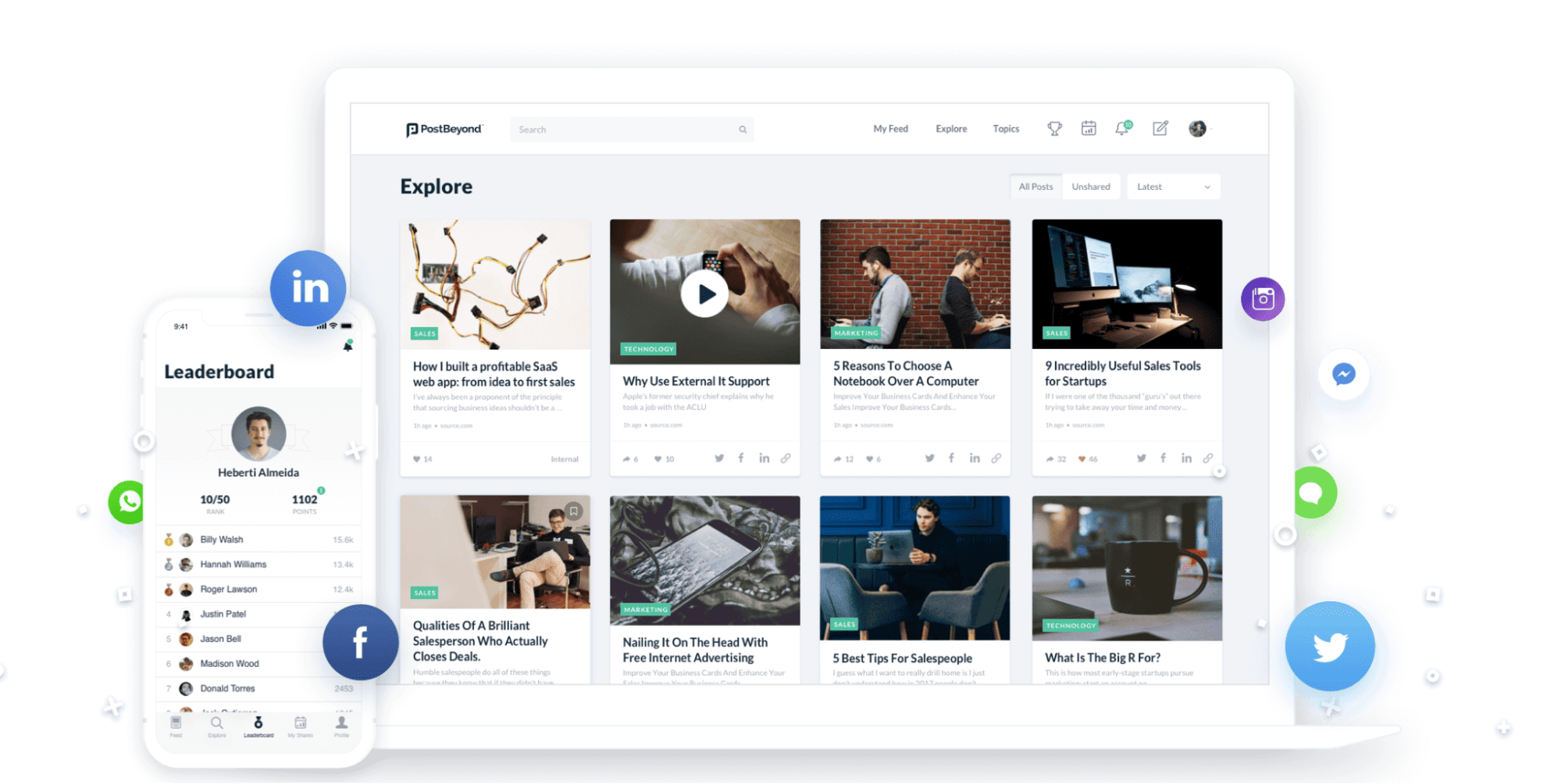
PostBeyond is another popular employee advocacy and social selling platform. It is commonly used by marketing and sales teams to extend campaign reach and support employee-led promotion on social media.
PostBeyond allows teams to curate approved content into shareable feeds. Employees can reshare posts to platforms like LinkedIn with suggested copy, while administrators track participation and engagement. The platform is often positioned where advocacy, lead generation, and sales enablement overlap.
Key features:
- Personalized content feeds for employees based on their interests
- Featured posts to showcase the most relevant ones to employees
- Internal post and advocacy for company announcements and internal comms.
- Actionable insights from social data with detailed reports and analytics
- Bookmarks to save evergreen posts to a personal repository
Pros:
- Well-suited for sales, marketing and HR-led advocacy and social selling programs
- Clear structure for distributing campaign content
- AI-powered content generation based on company guidelines
- Gamification features, such as team leaderboards, to boost engagement
Cons:
- Difficult to share content to certain platforms, as not all platforms are supported
- Sharing or navigation on mobile is not as smooth as desktop
- Analytics and insights are not granular for deeper measurement
Pricing:
PostBeyond has not published its pricing on its website.
Final Thoughts
Employee advocacy tools support a range of approaches, from structured content sharing to culture-led participation. The right choice depends on how you want to manage advocacy internally and how much control or flexibility your team needs.
Some organizations benefit from campaign-driven distribution tools. Others see stronger results by encouraging advocacy through visibility and internal alignment. Choosing a platform that fits existing workflows makes adoption easier and more sustainable.
If your approach focuses on surfacing and moderating employee-generated content, Flockler can support advocacy through social media aggregation and intranet-friendly displays.
FAQs
What are employee advocacy tools?
Employee advocacy tools help organizations support employees in sharing company-related content on their personal social media accounts.
What is the difference between employee advocacy and social media management tools?
Social media management tools are used for brand-owned channels. Employee advocacy tools focus on extending reach through employee accounts.
Do employee advocacy tools require employees to install new apps?
It depends on the platform. Some require a dedicated app, while others integrate with existing internal tools.
Does Flockler require employees to reshare content through a separate tool?
No. Employees publish content directly on social platforms such as LinkedIn. Flockler collects and displays approved posts without requiring employees to use a dedicated advocacy app or dashboard.
Can Flockler help with moderation and compliance?
Yes. Flockler includes moderation workflows that allow teams to review and approve content before it is displayed internally or externally. This helps maintain brand and compliance standards, especially in larger organizations.
Maria Prakkat is a SaaS content marketing and SEO strategist with experience across SEO, GEO, and social media aggregation. She writes in-depth, research-backed content that helps businesses understand and apply solutions like social media aggregators, UGC platforms, and content distribution tools to improve visibility and engagement. Her work focuses on clarity, relevance, and long-term impact.
Soziale Infrastruktur, die mit Ihnen skaliert.
Starten Sie Ihre kostenlose Testversion oder lassen Sie sich von uns die Plattform in Aktion zeigen.